
What happens when we move from “what rule was broken” to “what harm needs to be repaired”? This shift reflects a core aspect of restorative practices (Wachtel, 2013) and can fundamentally improve school climate.
In this article, I break down the 5 most common myths of implementing restorative practices in schools.
Restorative practice (RP) is often misunderstood as being a 'soft' approach to discipline that eliminates consequences. In reality, it's a relational approach (not a separate programme) that supports building a stronger, healthier community through accountability and thoughtful repair.
Restorative practices are a relational approach prioritizing relationships, wellness, and community connection. RP is not a separate programme; rather, it provides a framework for students, educators, and families to support positive culture, helping to build community, collaborate effectively, and manage challenges when things go wrong. Restorative practices are associated with reductions in disciplinary incidents and improvements in schools climate, social emotional skills, and student wellbeing (Alonso-Rodríguez, et al., 2025; Huang, et al., 2023).
Myth: Restorative practices are soft on poor behaviour
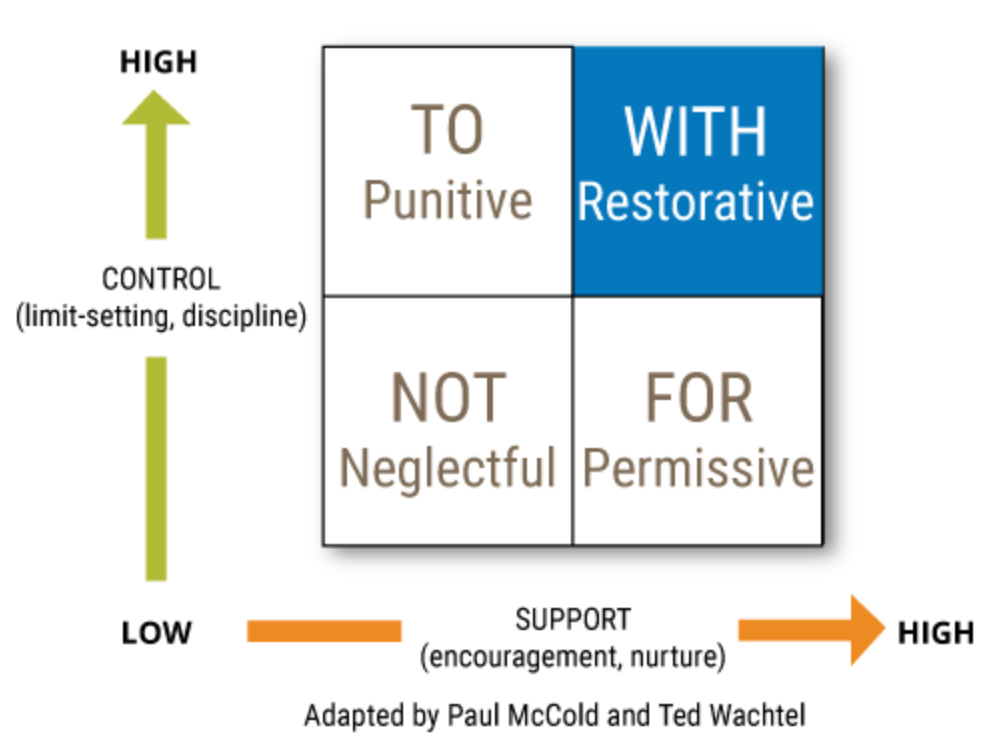
Truth: Restorative schools hold students accountable through reflection, responsibility, and repair. Using the model of the social discipline window (Wachtel & McCold, 2001), restorative approaches operate within the WITH framework of high accountability and high support. The approach supports those affected by conflict by identifying harm caused, directly addressing the impact on individuals and community, and identifying support needed for all involved. In this way, we can be more effective in resolving the harm done while building stronger, more trusting relationships. The goal is to directly address conflict and honour community expectations, while respecting the safety and individual experience of all individuals.
Myth: Restorative practices eliminate consequence
Truth: RP reframes consequences as moving beyond reactionary discipline measures to being rooted in actions that are logically connected to the harm caused. The goal is to support social emotional learning through student reflection and growth while more effectively repairing harm, supporting accountability and reintegration, and rebuilding trust (Morrison, Blood, & Thorsborne, 2005). Restorative schools do not tolerate behaviour that degrades the safety and sense of belonging of others.
Myth: Restorative practices can only be used for minor infractions
Truth: Restorative practices can be used to address and resolve minor and major conflicts, including bullying and violence. To be effective and ethical, restorative approaches must involve careful preparation and willingness of all involved to participate with appropriate support through a trauma-informed lens (Brummer & Thorsborne, 2021). As Principal, our school teams have successfully guided restorative practice in cases of violence, bullying, and vandalism. RP can and should involve external organizations when appropriate, such as law enforcement.
Myth: Restorative practices are only used for conflict resolution
Truth: Restorative practices exist along a continuum of approaches, from informal daily conversations to more formal processes, such as circles and conferences (International Institute for Restorative Practices, n.d.). Restorative schools use RP as a method for:
community building
determining essential expectations (norms)
student leadership training
finding common ground
guiding collaboration
Myth: Restorative practices take too much time and are just another add-on programme
Truth: Restorative practices are found to reduce repeat disciplinary incidents and strengthen relationships, thus potentially reducing the amount of time staff spend on reactive discipline while improving school climate (Augustine et al, 2018). RP is a relational approach that can be embedded into existing programmes and policies; it is not a separate pillar or siloed programme. When implemented with consistency, restorative practice replaces reactive punitive disciplinary systems with proactive, relationship-centred approaches that strengthen school culture, reduces repeat harm, and improves wellbeing outcomes for all members of the community.